Joan Hauber has dedicated more than three decades to life-saving work — early breast cancer detection.
By Elizabeth Chorney-Booth
Photographs by Ryan Parker

Back in 1991, when Joan Hauber landed a job as a clerk with Screen Test, the breast cancer screening program, she never imagined that nearly 35 years later, she would be managing Screen Test for the whole province or how different mobile screening would look. In the early 1990s, most Albertans, including Hauber herself, were only starting to learn about mammography and the benefits of early breast cancer detection.

The first mobile screening units in Alberta were vans filled with mammography and other clinical equipment that traveled to rural communities to set up makeshift clinics in health centres, community centres, churches or whatever spaces the program could find. Since those early days, Hauber has seen her own career in health care evolve and now oversees Screen Test program advancements that make it easier for Albertans to take advantage of regular breast cancer screening.
Today, in addition to a permanent screening facility in Edmonton, Screen Test runs two brand-new, state-of-the-art, digitally-equipped trailers that visit 120 rural Alberta communities every year, all under Hauber’s leadership. Mammograms can detect small abnormalities in breast tissue, often several years sooner than a physical exam would be able to, significantly increasing breast cancer survival rates through early cancer detection. With approximately one in seven women in Canada being diagnosed with breast cancer during their lifetime and one in 36 dying from the disease, Hauber’s zeal for advocating for the program’s continued evolution has helped countless Albertans uncover their breast cancer while it’s still easily treatable.
“People tell us they would never get a mammogram done if Screen Test didn’t come out to them,” Hauber says. “That’s the whole purpose of what we do — to make sure everybody has access to the same health care and the same service across the province.”
An unexpected passion for life-saving work.
Hauber — who grew up in Camrose, Alberta — took her initial job with Screen Test in Edmonton with little enthusiasm for health care, let alone mammography. With a degree in biology from the local Augustana University College, she thought she might pursue a career in ecology. But she needed a regular paycheque while she figured out her next steps. It turns out she did develop a strong interest in cancer screening.
“It happened quite by accident,” she says. “But it really was a position I found interesting, and I thought I would give it a try.” Attracted to the positive attitudes of the team at Screen Test, she was similarly drawn to the idea of making a direct impact on patients’ lives. The mobile screening program had just started when she accepted her entry-level position. Back then, not only did the technologists have to unload their equipment into a public building in each town but all of the imaging was captured on film, so they also had to set up remote darkrooms at each stop. Hauber says that, as rudimentary as the process may sound by modern standards, she and the rest of the team were proud to facilitate such a potentially life-saving service to Albertans.
“The group of people I was working with when I started here were so upbeat and positive,” she says, looking back. “There was a sense among us that this was important. We were making a difference by helping people in rural communities. And that has stuck ever since.”
An evolving service.

Providing patients in rural communities with mammograms may have felt a bit revolutionary in 1991, but Hauber and the rest of the screening team could not have predicted how much the program would change — and how Hauber’s career would grow along with it. In 1996, one van full of screening equipment grew into three. Hauber found herself being promoted into a leadership position, coordinating the northern portion of the Screen Test program’s growth and operational logistics.
“I took on a coordinator role to get one of the new mobiles up and running and to put everything in place to support that,” she says. “Then just as time went on, I continued finding different roles and responsibilities.”
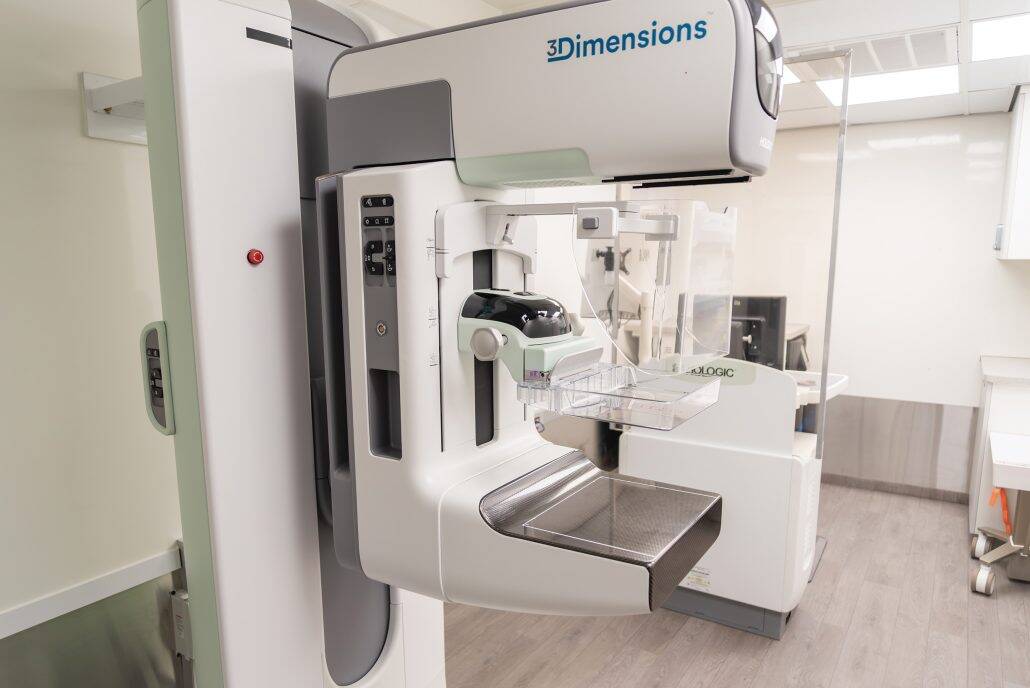
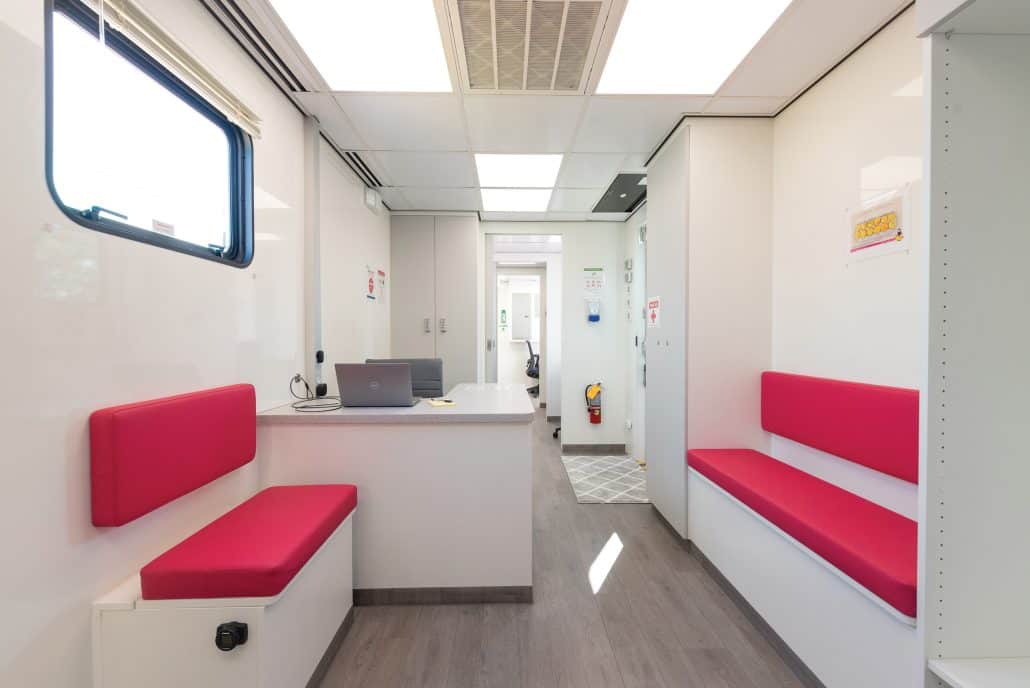
A bigger jump came in 2009 when the program did away with vans and darkrooms. Hauber was part of the committee that oversaw the transition to digital technology, which meant shifting to all-in-one trailers, allowing patients to more comfortably receive exams. While it meant the program’s fleet went down from three vans to two trailers, each trailer was given two teams of technologists, which expanded the capacity to screen patients.
“When I started, I would have never thought we would have two great big trailers sending images across the internet,” Hauber says. “But who’s to say what’s going to happen in the future? There’s all sorts of studies and research into different ways of finding cancers. Within 10 years, it could be so different from what we’re doing now.”
Driving into the future.
While Hauber may not know exactly what mobile screening will look like in a decade, she does know that after 15 years of service, that first fleet of digital screening trailers is getting an upgrade. With funding from the Alberta Cancer Foundation, the program acquired two new trailers in 2025 to replace those that hit the road in 2009.
The new trailers can better accommodate mobility issues and have tomosynthesis capability, allowing for 3D mammography, which provides a more detailed view of breast tissue than traditional 2D scans. Hauber is also working towards introducing a third, smaller mobile unit that will be able to traverse smaller remote rural roadways, potentially bringing breast cancer screening to communities the program has, so far, been unable to access.
The program has come a long way, and so has Hauber, who, true to form, keeps her focus not on her career but on leading her team to serve Albertans in as many corners of the province as possible. This commitment has no doubt played a key role in the longevity and impact of Hauber’s work in early cancer detection.
“We are decreasing people’s mortality from breast cancer,” Hauber affirms. “It is in part by early detection through screening, and also the advances we’re seeing in treatments. You put those two together and it just makes the outcomes even better. Everybody is working together and we’re doing our piece of it.”
Joan Hauber’s career highlights.
1991
Joan Hauber began working at Screen Test in an entry-level role with the mobile breast screening program.
1996
Takes on a coordinator role at Screen Test as it expands from one mobile unit to three, expanding its reach.
1997
Begins overseeing all aspects of the Screen Test North office and northern mobile units.
2001
Becomes coordinator for the entire provincial Screen Test mobile program in addition to the north office.
2009
Becomes the manager of Screen Test for both fixed and mobile sites, working with a committee to oversee the transition of the mobile program to digital technology to better serve rural patients.
2025
Hauber and her team launch two new trailers to replace the aging units and introduce new technology.