She’s advancing the understanding of glioblastoma by building new tools and integrating computational techniques.
By Colleen Seto
Photographs by Jared Sych
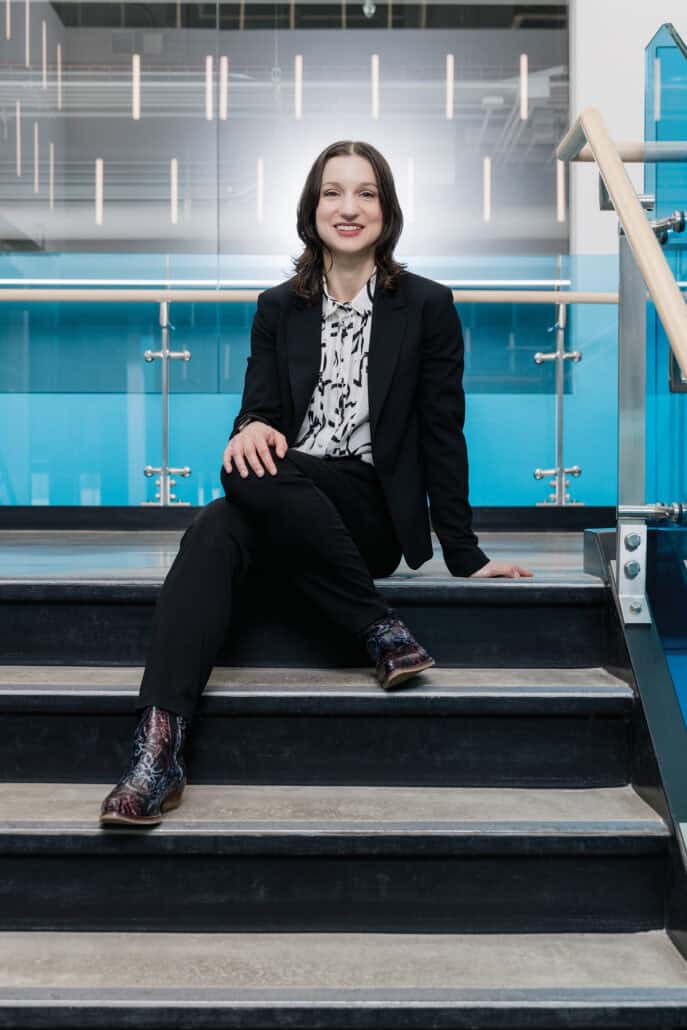
Ever since Dr. Ana Nikolic was a kid, she learned to think like her father, a computer engineer. He gifted her a copy of Learn Visual Basic, a how-to guide to programming, when she was only 11 years old, which kick-started her analytical thinking. “Learning how to code so early in life imparted in me a love for problem solving and programming logic,” says Nikolic.
Now, as a neuropathologist, researcher and an assistant professor at the University of Calgary, she puts those skills into practice to advance the understanding of glioblastoma, a hard-to-treat form of brain cancer in adults. In fact, her coding background gives her a unique perspective and skill set in the field of brain tumour biology and neuropathology in Canada, as she can apply new computational methods to her research. She also has a PhD in glioblastoma stem cell biology and epigenetics (the study of how behaviours and environment can cause changes that affect how genes work), where she explored cutting-edge experimental and computational methods.
“That analytical mindset makes me very comfortable building new scientific tools and integrating computational and experimental techniques to find answers,” Nikolic explains.
“As an MD PhD clinician scientist with expertise in brain tumour neuropathology, cell biology, molecular genetics and genetic engineering, Dr. Nikolic is exceedingly well positioned for this work and for gaining new insights into this devastating disease,” agrees Dr. Jennifer Chan, director of the Arnie Charbonneau Cancer Institute in Calgary.
From coding to brain tumour research
Though Nikolic is gifted in coding and won awards for her skills while still in high school, she decided to pursue medical school. “I first became interested in medicine when I spent a summer doing cancer biology research as an undergraduate student,” she recalls. “Realizing I could combine science with patient impact is what drove me to pursue medicine, with the goal of becoming a clinician scientist.”
And that’s just what she’s doing in her lab today — analyzing brain tissue samples to diagnose neurological conditions and help guide treatment.
Her research focuses on glioblastoma because, despite scientific advances, treatments and outcomes for glioblastoma patients have not improved. Most patients still die within a year of diagnosis.
“Seeing how devastating brain tumours were for patients and families, and how limited our treatments were, made me want to do something to change that. One of my relatives also passed away from glioblastoma when I was in medical school, which further motivated me to pursue this research as a career.”
—dR. ana nikolic
The challenge of brain tumour cells

Through the Calgary Brain Tumour Research Program at the Arnie Charbonneau Cancer Institute, Nikolic and her research team aim to better understand cellular evolution in glioblastoma — what controls how glioblastoma cells behave and adapt to different environments. Making this even more challenging is that every patient’s tumour has a unique mixture of cells.
“Glioblastoma tumours are remarkable in their adaptability,” Nikolic says. “These tumour cells are very good at changing their stripes to blend into different kinds of environments within the brain and evade our therapies. The tumour cells’ ability to change and evolve, which we call plasticity, limits many treatment approaches.”
Once they’ve determined what controls how and when glioblastoma tumour cells change their state, Nikolic and her team aim to stabilize them so they can be effectively treated. They’re doing so by developing tools to help characterize the inter-patient variability at the molecular level, in order to help build the next generation of targeted treatments, ideally with fewer side effects.
“What makes our approach unique is our toolkit,” she says. “We have developed tools that allow us to monitor the state of individual living tumour cells in real time, allowing us to directly see when and how they change, and how we can change them with therapy.”
“These epigenetic changes have been challenging to study due to a lack of tools that can track the rapid cell state changes,” adds Chan. “By developing unique molecular tools, Dr. Nikolic can now visualize key adaptions in real time — allowing next-level understanding of the mechanisms underpinning glioblastoma response and resistance. Her work is unique in its development and use of cutting-edge, integrated, molecular and computational approaches that can capture the dynamic changes in cancer cells.”
All in a day’s work

On top of her research, Nikolic has built an impressive publication record: 21 peer-reviewed publications, including three in frequently cited journals as a lead author. She is one of the first people worldwide to use a method called single-cell ATAC-seq (a fast laboratory technique that maps DNA protein structure) to study glioblastoma cells. She’s been at the forefront of this technology, building and publishing an open-source computational method, Copy-scAT, which allows scientists around the world to identify different types of DNA abnormalities in cancer cells through single-cell ATAC experiments.
All of this means that an average workday for Nikolic can include a wide range of activities. She might go from preparing an experiment in the lab to mentoring trainees and coding scripts on a high-performance computing cluster to e-mailing neuroscientists, computer engineers and brain tumour scientists across Canada to build collaborations.
In recognition of her work, Nikolic received a number of prestigious awards that have allowed her to follow her passion and advance her research.
Though much of Nikolic and her team’s research is still at the early translational stage — likely 10 to 15 years away from any large-scale clinical trials — she is very hopeful that the work will result in the ability to reprogram glioblastoma cells and treat patients.
In the meantime, Nikolic continues to meaningfully contribute to the scientific understanding of glioblastoma biology and is thankful to be able to do this work.
“Cancer charities and non-profit organizations have been key to supporting my research. Especially for uncommon tumours like glioblastoma, community support is essential to helping us keep this research going.”
—dR. ana nikolic